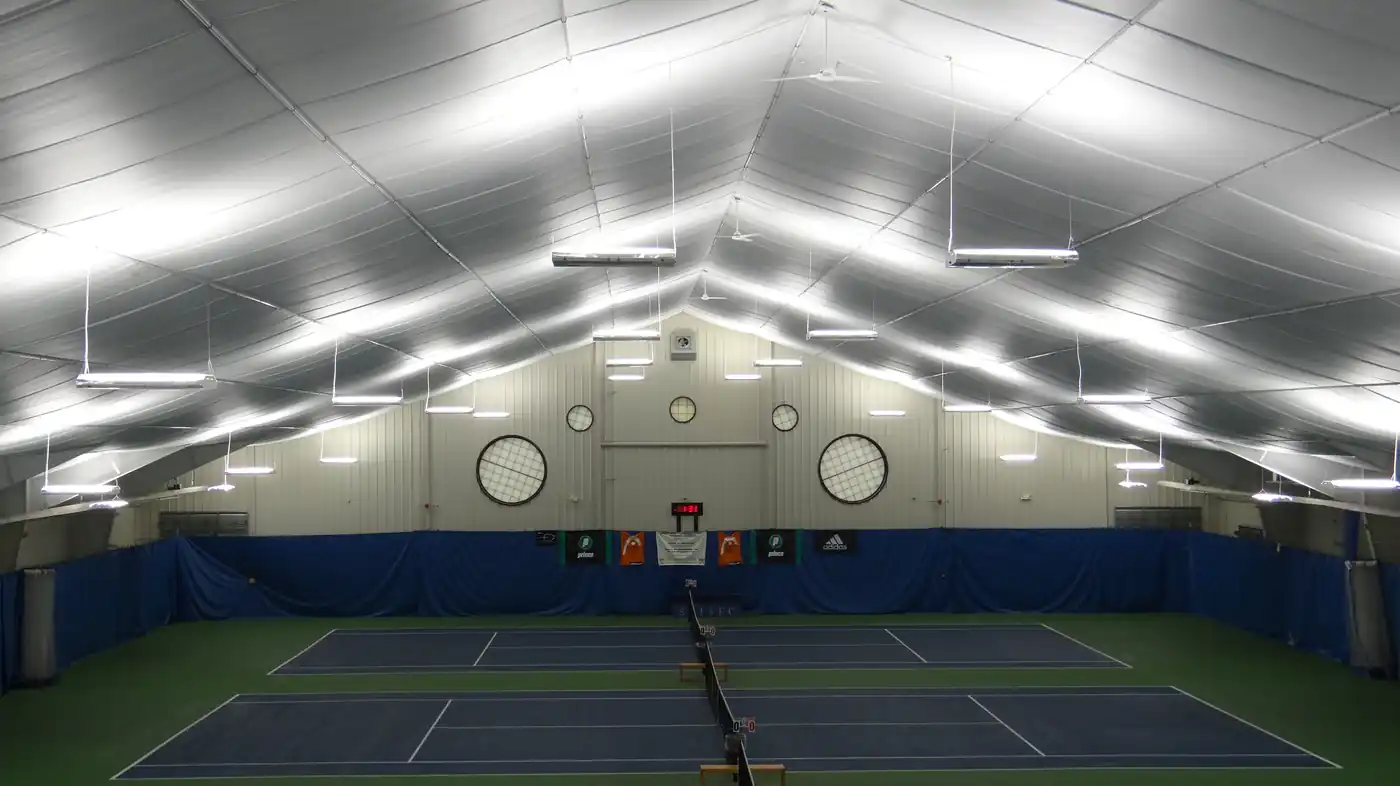
Ohio gives you about five good months of outdoor tennis a year. Here is how to play the other seven — what indoor court time actually costs around Dayton, how booking works, and what separates a club you will stick with from one you will quietly stop driving to.
Every spring, the courts at the public parks fill up. People dust off a racquet, play three or four times in May, a couple more in June, and then it gets to ninety-four degrees with the humidity to match and the whole thing quietly stops. By late October the nets are down. By December nobody is talking about tennis at all.
That is the pattern for most players in the Miami Valley, and it is worth naming because it is not a motivation problem. It is a facilities problem. Dayton averages around 130 days of measurable precipitation a year, and the stretch from November through March is effectively unplayable outdoors. If your tennis depends on the weather cooperating, you get a hobby you are good at for about six weeks a year and rusty at for the rest.
Indoor tennis solves that, and it is less exotic and less expensive than most people assume. This is a plain guide to how it works.
The obvious benefit is that it does not rain inside. The real benefits are less obvious and matter more.
The ball behaves the same way every single time. No wind pushing your toss two feet left. No sun in your eyes on one end and not the other. No damp patch in the service box. When the conditions stop being a variable, you find out what your groundstrokes actually do — and so does your coach. Almost every player who moves indoors improves faster, not because they are trying harder, but because they are finally getting consistent feedback.
You can book at 7:00am in January. Consistency is the whole ballgame in adult tennis. Two sessions a week for a year beats five sessions a week for two months and then nothing. Indoor courts are what make a year-round routine possible in a climate like ours.
The social side stops resetting. Outdoor tennis groups dissolve every autumn and have to be rebuilt every spring. Indoor clubs run leagues and clinics on a continuous calendar, so the people you play with in February are the people you played with in September. That sounds like a small thing. It is the single biggest reason people stay in the sport.
Most indoor courts in this region are hard courts, and they play slightly faster and lower than a well-worn outdoor public court. If your first indoor session feels rushed, that is why — not you. Give it two or three visits.
This is where people guess wrong in both directions. Some assume indoor tennis is a country-club expense. Others assume it is the same as walking onto a public court, which it is not — somebody has to heat a building the size of a warehouse.
Indoor court time is priced by the hour and by the slot, and the spread between the cheapest and the most expensive hour is enormous. At South Regency the range runs like this:
| When | Rate |
|---|---|
| Weekday mornings, 7:00–9:00am | $26/hr |
| Weekdays, 9:00am–6:00pm | $36/hr |
| Weeknight prime, 6:00–10:00pm | $40/hr |
| Weekends, 8:00am–2:00pm | $40/hr |
| Weekends, 2:00–6:00pm | $38/hr |
Split between two players, a weekday morning hour is $13 each. Split between four for doubles, it is $6.50. That is cheaper than a spin class, and you were going to be awake anyway.
The practical takeaway: a flexible schedule makes indoor tennis dramatically cheaper. If you can play before nine in the morning, you are paying roughly 35% less than the person who can only play at seven in the evening, on the identical court, with the identical lighting. If mornings genuinely work for you, ask about a season pass rather than paying by the hour — ours is $70 a month for unlimited weekday mornings, which pays for itself in the third hour.
Here is the thing that confuses newcomers most: at almost every indoor club, reserving a court yourself is a membership privilege. It is not a paywall for spite — it is because eight courts against a whole city's worth of demand needs a reservation system with accountability behind it, and that means accounts.
But that does not mean you have to join before you can play. There are three doors in, and only one of them requires membership:
If you find yourself playing more than about twice a month, run the arithmetic on membership. At the point where you want to pick your own hour on your own day with your own friends, that is what membership buys.
Court count and price are the two things people compare, and they are the two least predictive of whether you will still be playing there in a year. Here is what matters more.
Does anybody organise the tennis, or do they just rent you a room? This is the big one. A club that runs seven drop-in clinics a week, places new players on teams personally, and knows who needs a fourth on Thursday is offering something structurally different from a facility that hands you a key card. Ask how a new player with no partner gets into a game. If the answer is vague, keep looking.
Is there a real path for your level? A club with nothing but 4.0 leagues is useless to a 2.5 player, and a club with nothing but beginner clinics will bore an experienced one within a month. Look for a ladder that goes from genuine never-played through to competitive, with a way to move between rungs.
How many courts, and how are they used? Eight indoor courts sounds like a lot until you learn that six of them are permanently booked by contract holders. Ask what is actually available in the hours you can play.
Ceiling height and lighting. Unglamorous, and you will notice both within ten minutes. Low ceilings kill the lob and the high defensive ball. Poor or uneven lighting makes overheads a lottery.
Is there anything for the rest of your household? The most common reason people quit a club is not the tennis. It is that their kid had nowhere to go and their partner had no reason to come.
We have been on West Tech Road in Miamisburg since 1999. Eight indoor hard courts, five outdoor, six indoor pickleball courts, a 2,800 square foot fitness center in two separate rooms, and an outdoor pool in season. We are off I-75 just south of Austin Landing — roughly ten minutes from Centerville or Springboro, twenty from downtown Dayton, and parking out front is free.
A few things that are genuinely unusual about the place:
All eight indoor courts are PlaySight SmartCourts. Every point you play is recorded and streamed automatically, at no cost on top of your court time, with nothing to switch on. Most clubs our size manage one show court if they manage it at all. It means your parents in another state can watch your league match live, and it means you can pull up the rally you just lost between games.
Eight pros, more than 150 years of teaching between them. A Division I All-American, a Dayton Tennis Hall of Fame inductee, an OHSAA state singles champion, and coaches who came up through this club's own junior program and never left.
Seven drop-in clinics a week, from Monday-night Adult Beginner through coed all-levels sessions at lunchtime and in the evening. No sign-up, no partner, and we lend racquets at the desk.
No appointment needed. Turn up, and whoever is on the desk will walk you round the building without turning it into a sales pitch. If you would rather just start playing, the Monday 7:00pm Adult Beginner clinic takes total newcomers every week.
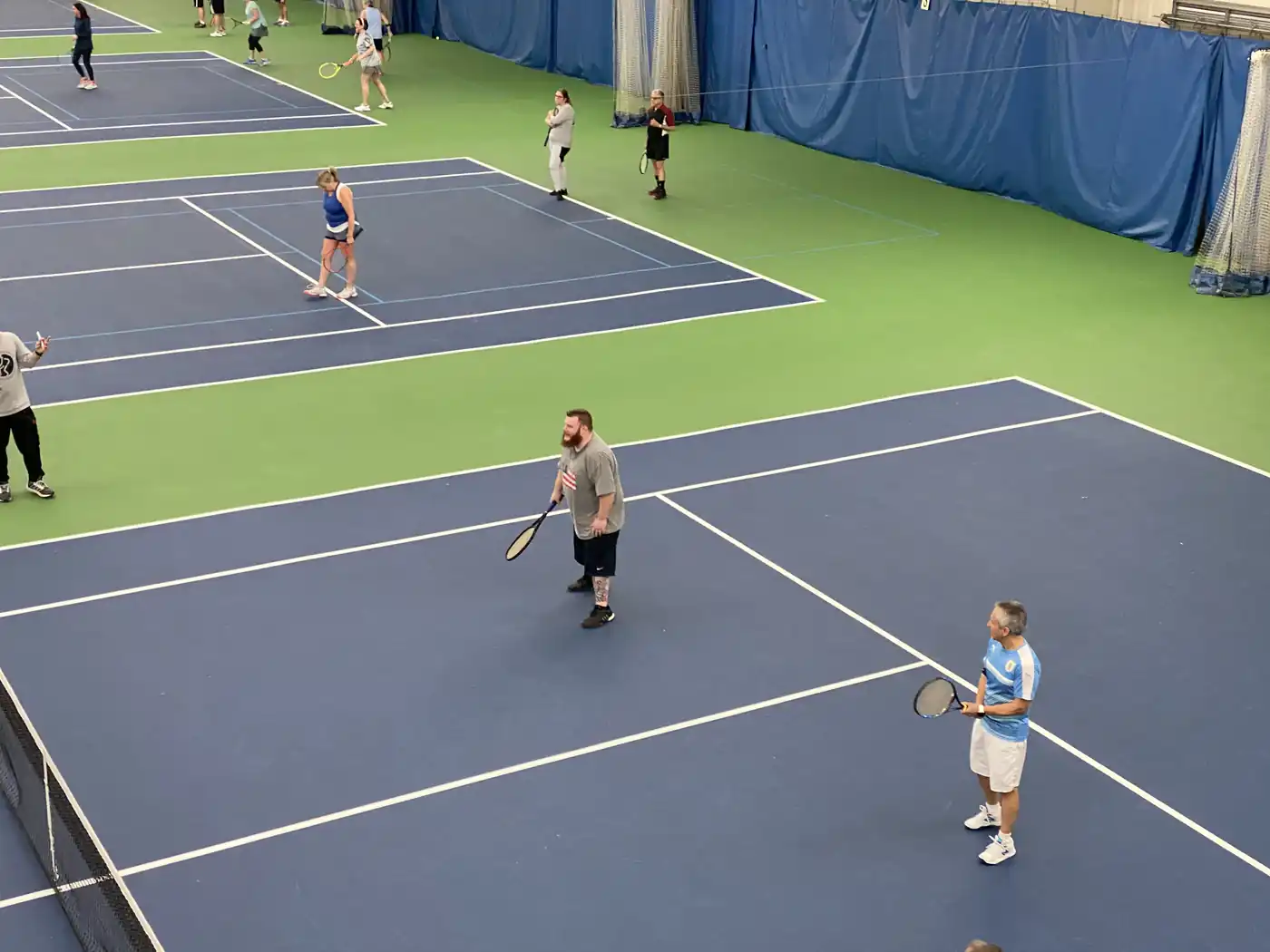
No partner, no racquet, no need to get fit first. What actually happens when an adult who has never played walks into a beginner clinic, and what the first six weeks really look like.
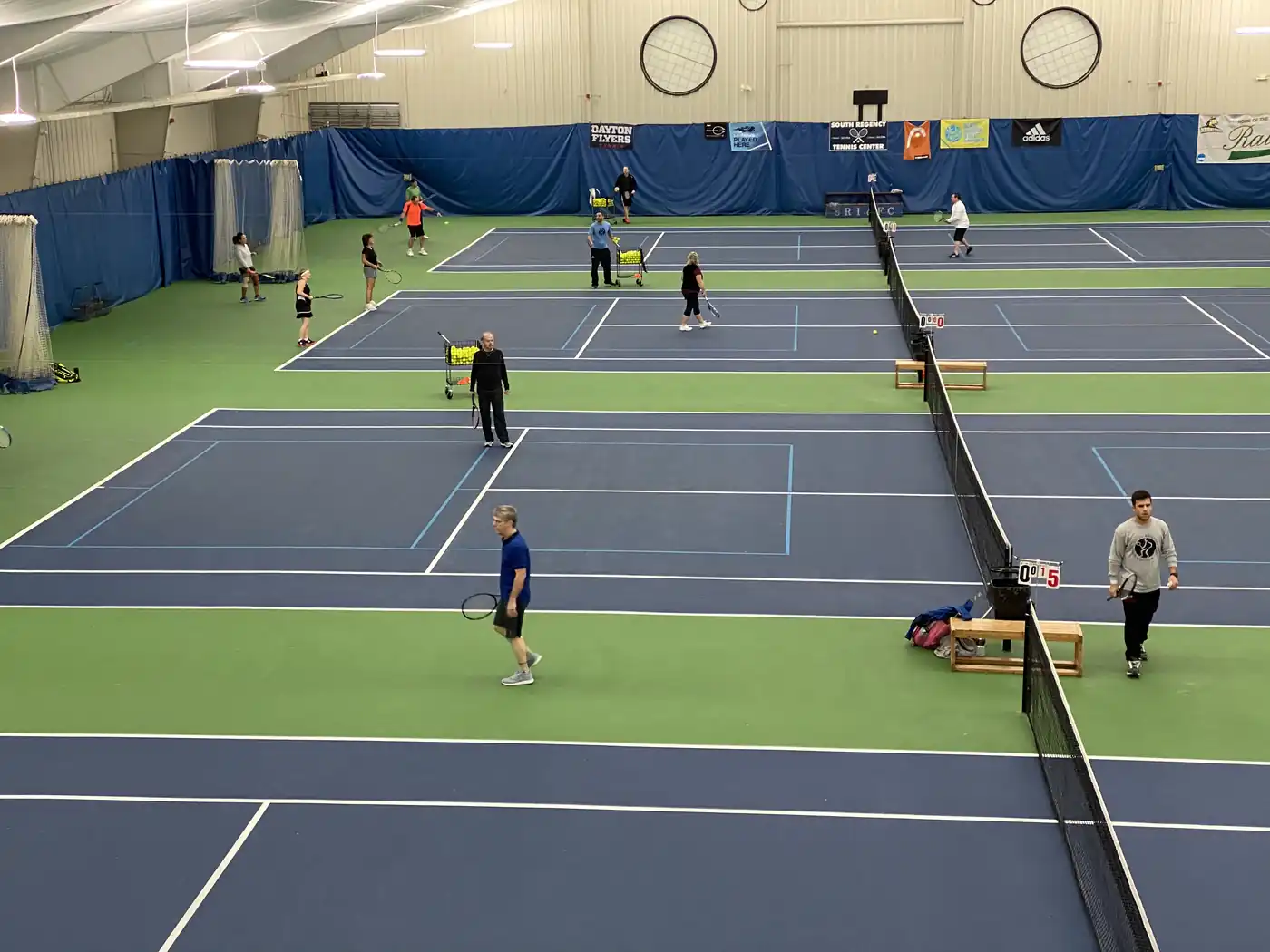
The numbers on every clinic schedule and league listing, translated into plain English. What each level looks like on court, how to work out yours, and why guessing low is the right move.